Mildura Arts Centre is the leading arts, culture and heritage hub in North West Victoria.
The precinct boasts a gallery, theatre, heritage house, Sculpture Park, and Vista Cafe Bar. The venue offers free entry to the art gallery and Rio Vista Historic House.
Car parking available. This is a must-see attraction in Mildura.
Nature has a nightlife, and it's glowing
As night falls along the Murray River, thousands of lights begin to glow. Gentle illumination draws out the landscape, light shifting through the trees, quietly transforming a river island after dark.
This is Trail of Lights, an immersive walking experience in Mildura, created by Bruce Munro, the artist behind Field of Light at Uluru and his latest installation - Fibre Optic Symphonic Orchestra (FOSO) in Wentworth NSW. Walk through 12,500 firefly lights and Munro's iconic Gone Fishing sculptures.
There's no schedule, no rush, just a space for reflection, connection and wonder.
Mildura Holden Motor Museum houses a private collection of Holden's starting from the very first 48-215 right through to the latest Monaro and Statesman. The vehicles were mainly collected by one man, Mr Ron Morello over a 40 year period who always had a passion for Holdens.
If you appreciate the history of a well-restored vehicle then the Mildura Holden Motor Museum is a must-stop if you are in the Sunraysia district.
Come and enjoy a quiet coffee and lunch in the cafe while reminiscing over the history. And of course, there is a merchandise store there for you to take home a souvenir or two.
Australia's most unique Botanic Gardens, a prime example of what community spirit can achieve, is on display at the Australian Inland Botanic Gardens (AIBG). Set on 50 acres the plantings showcase Australian arid and exotic flora, including a rose garden featuring over 1,600 colour coordinated bushes.
Visitors can enjoy a tractor-train tour through the gardens every Saturday at select times or by appointment.
Garnpang Homestead and coffee shop is open daily, so relax over coffee or lunch and browse through a selection of handcrafted gifts. On the fourth Saturday of each month is a sumptuous breakfast made by talented volunteers.
The AIBG has opened a Children's Garden. It comprises play equipment made from recycled materials. made by volunteers which include school students. This is a place to play in a natural environment. There is a cubby house, sand pit and musical instruments. There is no entrance fee, but a donation for the garden's maintenance is welcome.
Orange World is a fantastic working citrus property that has a tractor-train tour of the orchards, with informed commentary on the unique facets of the industry that relate only to this area. The tour also includes the nursery, varietal plantings, a visit to the lookout tower and a packing shed.
Fruit grown include oranges, mandarins, grapefruit and avocados. With 10,000 trees and a turnover of over 20 million fruit annually, Orange World is truly the land of the living orange!
The Orange World kiosk sells souvenirs, soft drinks, toys, ice cream, gifts, sunglasses, t-shirts, hats, fresh fruit and pure fresh orange juice. There are picnic areas and toilet facilities available.
While there is free entry to the kiosk and café area, the best experience is gained by taking the tractor train tour. Three tours run daily, each taking approximately one hour and including Lookout Tower, Nursery, Packing Displays and Tastings. Costs apply for the tour.
Orange World is closed in February.
The Garden of Hope aims to provide an encouraging place for individuals, families and groups to come, relax, have fun, play games or enjoy a coffee and slice.
The Garden of Hope is on 16 acres of land by the edge of Lake Hawthorn, just five minutes from Mildura. Wander the beautiful garden filled with creative artwork and inspirational quotes on Hope, and be encouraged to keep going no matter how tough it gets. The lake, birds, gardens, flowers, music and quotes make it the perfect place to relax, unwind and be encouraged.
The Garden of Hope is being developed as a great multifunctional family place. This place is for all ages, families and people groups with playground, games, activities, 18-hole mini-golf course (cost extra), kiosk, souvenirs, cafe, drinks and ice-creams. It is available for various functions including birthdays, weddings, wakes, baby showers, pre-schoolers, youth groups, specialty groups and your special occasion.
There are various community events and fun motivational programs held each year. Entry fees apply in most cases. For some events like the Easter Egg Hunt the entry fee is slightly more to cover extra costs. Other events there may be no entry fee, for example Carols by Candlelight and Australia Day Breakfast.
The Red Cliffs Historical Steam Railway was formed in 1994 under the auspices of the Red Cliffs Rotary Club to operate the restored Kerr Stuart 0-4-2T steam locomotive named 'Lukee' B/N 742/1901, that formerly operated between Red Cliffs railway station and the Red Cliffs pumping station. A two kilometre section of the former 1600 millimetre gauge Red Cliffs. Morkalla branch line has been converted to 610 millimetre gauge for tourist train operation.
In 2004, Red Cliffs Historical Railway purchased an EM Baldwin diesel locomotive which after extensive renovation by members Russell Savage and John Page was commissioned in June 2005. Named 'Harry' the Locomotive regularly shares running days with 'Lukee' and gives the Railway the flexibility of one off specials.
Red Cliffs Historical Steam Railway is located on the corner of the Calder Highway and Millewa Road Red Cliffs and is approximately two kilometres from the Red Cliffs township.
The Railway operates on the first Sunday of the Month except January and February.
The Railway also operates on the Sundays of Victorian Labour Day and Queen's Birthday long weekends and Easter Sunday
Coomealla Golf Club is a picturesque golf club on the banks of the mighty Murray River.
Situated right on the banks of the Murray River, the Coomealla Golf Club is arguably one of the country's finest.
The Coomealla Golf Club offers a comprehensive range of facilities, including a comfortable, air-conditioned clubhouse. Light snacks and meals are available, complemented by a well-stocked bar.
There is the welcoming Pro-Shop with a comprehensive range of equipment for sale and hire and knowledgeable staff to assist you with your game.
There is a popular outdoor barbecue area suitable for all occasions with family and friends.
Bottle Bend Reserve is a spectacular Murray River destination near Monak in south-west New South Wales, offering visitors an authentic Australian bush experience. The reserve features peaceful riverside camping, scenic walking tracks, birdwatching, fishing, canoeing (with a great boat ramp), photography and opportunities to experience the unique landscapes of the Murray floodplain.
The reserve protects significant Blackbox forests, redgum woodlands, wetlands and native wildlife, making it an ideal destination for nature lovers and outdoor enthusiasts. Visitors can relax beside the Murray River, explore diverse ecosystems and enjoy stunning sunrises, sunsets and star-filled night skies.
Bottle Bend Reserve also celebrates the rich cultural heritage of the Kureinji People, Traditional Owners of the area. Interpretive experiences highlight Aboriginal culture, environmental stewardship and the importance of the Murray River to generations of First Nations people.
Managed by a dedicated volunteer Committee of Management in partnership with the community, Crown Lands NSW and environmental agencies, the reserve continues to evolve through conservation, environmental watering projects and visitor improvements.
Whether you're camping for a weekend, exploring the walking trails, fishing on the Murray or simply seeking a peaceful escape into nature, Bottle Bend Reserve offers an unforgettable outback river experience just a short drive from Mildura and Wentworth.
The Wentworth Military Collection is home to the Marching Matilda Experience. A state-of-the-art self-guided audio tour, which provides both an adult and junior immersive journey of discovery through over 125 years of Australian and international military service.
Established as a Military Museum and registered New South Wales War Memorial, the collection is perfect for individual travellers, family visits or special interest groups including educational excursions.
A reflective tribute to all who have served with the solemn message of peace and resolution.
O'Donnell Park at Curlwaa is a picturesque park on the banks of the Murray River. It is a scenic place to enjoy a snack and a picnic, let the children enjoy time on the playground or simply relax from a long drive.
The park is named after Larry O'Donnell, a prominent Curlwaa man. Mr O'Donnell worked tirelessly for the good of the settlement and its industries, particularly those of dried fruits, water and salinity issues.
In the park also is a monument erected in 1959 to thank and recognise all those who worked tirelessly to save Curlwaa from inundation of the 1956 flood waters.
The Junction Island Nature Reserve and Walking Track is the shoal of land between the Darling and Murray Rivers. Take a leisurely stroll along the wide cleared footpath to the point of the island , approximately 1 km in length
The junction sandbar is where a large number of Traditional Owners, armed with spears and weapons, threatened Captain Sturt as he sailed down the Murray on his expedition to find the inland sea. Luckily the Traditional Owners were calmed down by four Traditional Owners from across the river whom Sturt had befriended earlier and therefore the intruder's presence was accepted.
Visit the Island and stand on the footbridge between both the Darling and Murray Rivers, or follow the gentle track and walk to the point where the rivers meet.
Standing right in the middle of Australia's two greatest rivers is a unique Australian experience not to be missed.
Flora, fauna, wildlife and birdlife abound within this island reserve. A canoe tree is located at the beginning of the walking track that leads to the point.
David James Jones better known as The 'Possum' ,a local bush legend , lived for 50 years off the land and as a hermit around the Wentworth area.
A life-size statue of a man known as 'The Possum', who, when disgruntled by life during the "Great Depression" (1929), took to living off the land around Wentworth and Renmark. He slept in trees (thus his name), walked many miles, swam the rivers, lived the life of a hermit and avoided human contact for some 50 years before his death at the age of 81.
A proud man, 'Possum' worked for graziers in exchange for food and clothing, although he would always wait until the folk had left for town before he began his work. He was known to upset some of the property owners when he let the dogs loose because he felt sorry for them.
Hear his story via voca-phone in the green metal box close to the statue.
Possum books are available for purchase at the Wentworth Visitor Information Centre.
Built at Morgan, S.A., in 1907, she was the 4th paddle-steamer to be called 'Ruby'. She transported passengers and cargo between Echuca, Mildura, Wentworth and Goolwa. After a long and busy life, Ruby slowly fell into disrepair, ending her days as a houseboat at Mildura.
Ruby was purchased by the Rotary Club of Wentworth in 1968 and was dry docked in Fotherby Park, as a reminder of the riverboat era. In 1995, the Rotary Club handed ownership to the Wentworth community, in the trusteeship of the Wentworth Shire Council.
In 1996 a Restoration Committee was formed from representatives of local organisations and the Wentworth Shire Council. Six years and 1000's of volunteer hours later, Ruby had a brand new hull and she was returned to water in a dock pond. Excitement grew as the steam engine became operational. She was all steamed up for her 100th Birthday in 2007. The P.S. Ruby is not currently in operation; however, you can still go and visit her docked behind a wire fence at Fotherby Park.
John Egge was born in Shanghai China in 1830. As a young man he worked on a sampan on the Yangtze River. At the age of 16, he sailed to Australia as a cabin boy with Captain Francis Cadell.
Egge was the cook on Cadell's PS Lady Augusta which raced with Captain Randall's vessel, PS Mary Ann in 1853.
In 1866 he chartered his first ever riverboat PS Treviot. By 1870, Egge was established as one of the biggest traders on the Murray Darling and his on-shore business interests had expanded at the same rapid rate as his river trade.
Captain Egge died in Wentworth in 1901 and is buried in Wentworth Cemetery. Walking cemetery guides are available from the Wentworth Visitor Information Center.
A bronze statue of Captain John Egge was unveiled at the Wentworth Wharf on 12 June, 2009, during the 150th Anniversary of Wentworth. The statue was commissioned by the Wentworth Branch of the National Trust and sculpted by Lynne Edey.
The Wentworth Wharf was originally built in 1879 using local timber and was a major landmark of the town - a hive of industry. Boats, large and small were to become a 'way of life' in the town on the junction of the Murray and Darling Rivers. Throughout the riverboat era, Wentworth was the busiest inland port within New South Wales (the third busiest port after Sydney and Newcastle). During one week 31 steamers were docked at the wharf, with planks joining steamer to steamer.
The original wharf deteriorated and was demolished in 1983. A replica was built (including the little customs office) and now stands in its place, a great tribute to the once-bustling river trade era.
Come and check out what is possibly the largest and only Model Paddlesteamer collection of its kind in the entire world, with over 30 hand-made replicas hand-crafted with amazing and intricate detail.
A lifetime of work on display. Riverboat Rod constructs each Paddle Steamer as closely as possible to the original design.
Many boats Rod has built range between 300 and 700 hours. The attention to detail is just incredible and some of his models now feature in museums around Australia and at the Wentworth Shire Council's office.
A donation on entry would be very much appreciated to help Rod cover the expense of printing the information pamphlets with detailed descriptions of each steamer, that are also available.
Visit a working weaving studio that is open to the public. Experience hand loom weaving techniques that for centuries have been used to create fabric from fibres.
Try your hand at weaving using small easy-to-use table top weaving looms. View the range of hand-woven items from clothing accessories, and soft furnishings to fabrics for garments.
Take home a memento of your visit from the range of items for sale.
The Church of St Francis Xavier is the first Roman Catholic Church built along the Darling River and the second church built in Wentworth. The foundation stone for Saint Francis Xavier Church was laid on June 18, 1871, in a ceremony held in pouring rain. Although the structure was incomplete at the time the first mass was held in the Church in the early part of November 1872, by Reverend Matthew Ryan.
Architecturally, the building is a striking brick structure with a steeply pitched corrugated iron roof. Its facade is dominated by a large, elongated stained glass feature window, a brick tower with crenellated edging, and decorative stucco quoins highlighting the smaller arched side windows. The church is a prominent stop on Wentworth's local history and heritage trails.
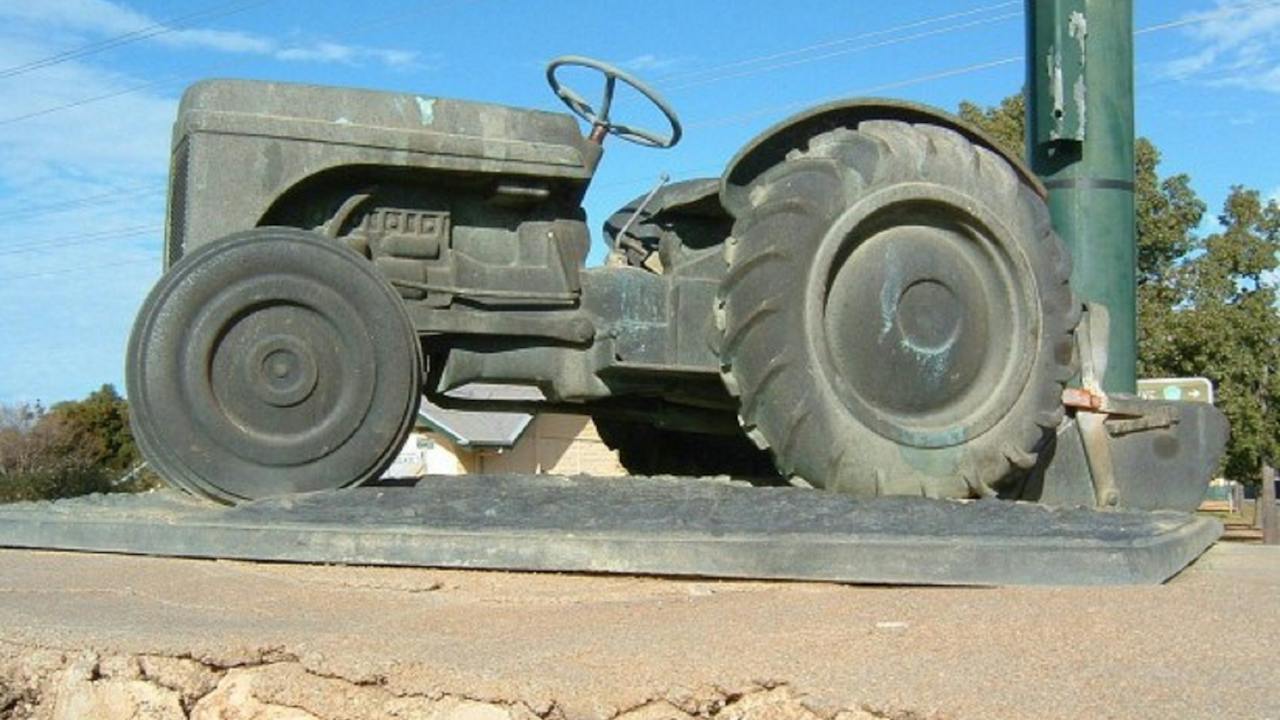
The 'little grey' TEA20 Fergie tractor wrote itself into local history books through the integral part it played in saving Wentworth from the 1956 floods.
Flood waters raced towards Wentworth via both the Darling and Murray Rivers, resulting in a whole third of Wentworth going underwater. Wentworth became an island in an inland sea.
The tenacious will of the Wentworth people saw them stay and fight to save their town from rack and ruin when all authorities were urging them to evacuate.
During the floods, the roar of the little Fergies could be heard 24 hours a day as volunteers patched and built crumbling and new levee banks to fortify Wentworth from the rising waters.
The first Tractor monument in the world was erected in the roundabout of Adelaide and Adams Streets in Wentworth in 1959 and still remains there to this day. The monument was established by the people of Wentworth in honour of the TEA20 Harry Ferguson tractors' part in the building of the massive levee banks that protected Wentworth against the devastating 1956 floods. The Cairn of stones where the monument sits is set at the height which water would have inundated the town if the clay levee banks had not been constructed.
The Wentworth Sporting Complex on 10.4 hectares incorporates an 18 hole championship golf course with magnificent greens, 14 tennis courts with eight on supergrass, and one active bowling green.
Situated next to the Old Wentworth Gaol, the 18-hole Wentworth Golf Club is picturesque in every sense. Even if the weather is hot, there's no shortage of water on the course with lakes punishing those who are wayward golfers. Motorised carts, buggies and clubs are available for hire.
The Wentworth Tennis Club has a total of 14 courts. Eight are on supergrass and four are under lights. Social tennis is encouraged at any time. Ladies' social tennis is every Thursday morning. Courts are always open for members and visitors to use.
The Wentworth Bowls Club has a great green to play on, which is supergrass. Visitors are more than welcome to have a social bowl at any time with club social bowls played on a Wednesday morning.
Wentworth Pioneer Museum houses an interesting historic collection of much of Wentworth's heritage. The Rotary Club have collected over 3,000 artefacts and relics covering all aspects of the history of the Wentworth Region and surrounds. Here in the Wentworth Shire, fossils of Australia's Megafauna have been found in a number of locations.
The Megafauna replicas exhibited at the museum include a Diprotodon, a Procoptodon, a Genyornis and a Thylacteo. The scale of these models has been determined by actual skeletons. The museum also houses a large paddle steamer display which includes various models and photos of many river vessels.
There are numerous other exhibitions to see including Space Junk, a 90-pound Murray Cod, a 1942 W.L.A Harley Davidson Motorbike as well as numerous reminders of how hard early life was in Australia. It's well worth this visit to find out the history of this great region, explore the heritage and appreciate time gone by.
The junction of Australia's two longest rivers, the Murray and the Darling - an iconic Australian 'must-see'!
Climb the viewing tower and see the confluence of the Murray and Darling Rivers, which, combined, is the fourth largest river system in the world. When the Darling is in flow, a surprise awaits - as the two rivers are marked by a distinct colour difference visible from the tower. The Darling is a clay-based river; its milky appearance contrasts starkly to that of the mighty Murray. Truly one of Australia's iconic 'must-see' attractions.
You can climb up to the viewing tower and look down upon the confluence of the two majestic rivers, take a stroll along the walking track, take advantage of the facilities on offer for a barbecue or picnic or read up on the history of the Darling River in the pictorial informational gazebo.
There is a playground for the kids to wear out some energy whilst you enjoy the tranquility of the region.
A series of locks and weirs were built along with the river systems with the Wentworth weir and lock completed in 1929. Lock 10 and Weir are located near the Confluence of the Murray and Darling rivers. The purpose of the weir is both to maintain a high level of water for irrigation in times of low water and to regulate water flow. The lock enables boats to pass from the upper stream to the downstream level of the Murray River and vice versa.
To allow the migration of fish species upstream past the weir at any time, special 'fishways' have been built at the abutments of Lock 10. A series of interconnected pools allow the fish to move from pool to pool as part of their upstream travel. This is an important step in the long term recovery of the River Murray ecology.
The weir and lock area is fitted with various picnic tables and barbeques across the road for those wishing to have lunch and enjoy the view.