Places worth discovering

Things to Do

Find attractions, experiences and places to visit. Events remain the best way to see what is happening on a particular date.

Looking for a dated event? Explore Events

159 places

Explore local places

Brown’s Mart, Darwin

Historical Sites and Heritage Locations

Brown’s Mart, Darwin

Brown’s Mart in Darwin is a unique building that dates to the 1880s and is highly regarded as a landmark in the city. Built of porcellanite stone, it has a corrugated iron roof and is considered to have architectural, historic and social significance. Architect JG Knight designed new premises for VL Solomon & Co in 1885 and it became known as Solomon’s Emporium, the finest stone store in Palmerston (Darwin’s then name). From 1887-1910, the building was known as the Mining Exchange where the Port Darwin mercantile agency, run by JAV Brown and HH Adcock, operated as importers, customs and shipping agents. Its use as a shipping agency and auctioneering venue continued until it was leased by the Bank of New South Wales in 1937 while its own building was constructed. The building suffered substantial damage in a cyclone in 1897. During WWII, it was converted to a torpedo workshop. After the war it was used by the Navy until about 1952. It then housed the police force, the Crown Law Office and the Motor Vehicle Registry. The building was repaired after Cyclone Tracy in 1974 and has been used as a community theatre since.

Darwin City NT

0.0 km away

View place
Town Hall Ruins, Darwin

Historical Sites and Heritage Locations

Town Hall Ruins, Darwin

The Town Hall ruins are all that remain of the original Palmerston Town Hall designed in 1882 and completed in 1883. It was used for civic purposes until the Navy occupied it during the war years. When peace returned, the building was used as office space by the Museum and Art Galleries Board. The building was so severely damaged by Cyclone Tracy in 1974 that it was not rebuilt. The remains were stabilised in 1980 since when the ruins have been developed as a public open space and visual arts performance venue. Conservation works are effected from time to time. The original building was a simple rectangular plan constructed of local stone with a corrugated galvanised iron roof. The building incorporated space for the Council and the Palmerston Institute, with its reading room and library. It was constructed of local stone and enough cypress pine from Indian Island to timber the floor and a roof, according to the contractors. While its original heritage significance is as a grand public building, it has attracted a second - and, some would argue, more important - layer of significance as a testament to the might and fury of Cyclone Tracy.

Darwin NT

0.1 km away

View place
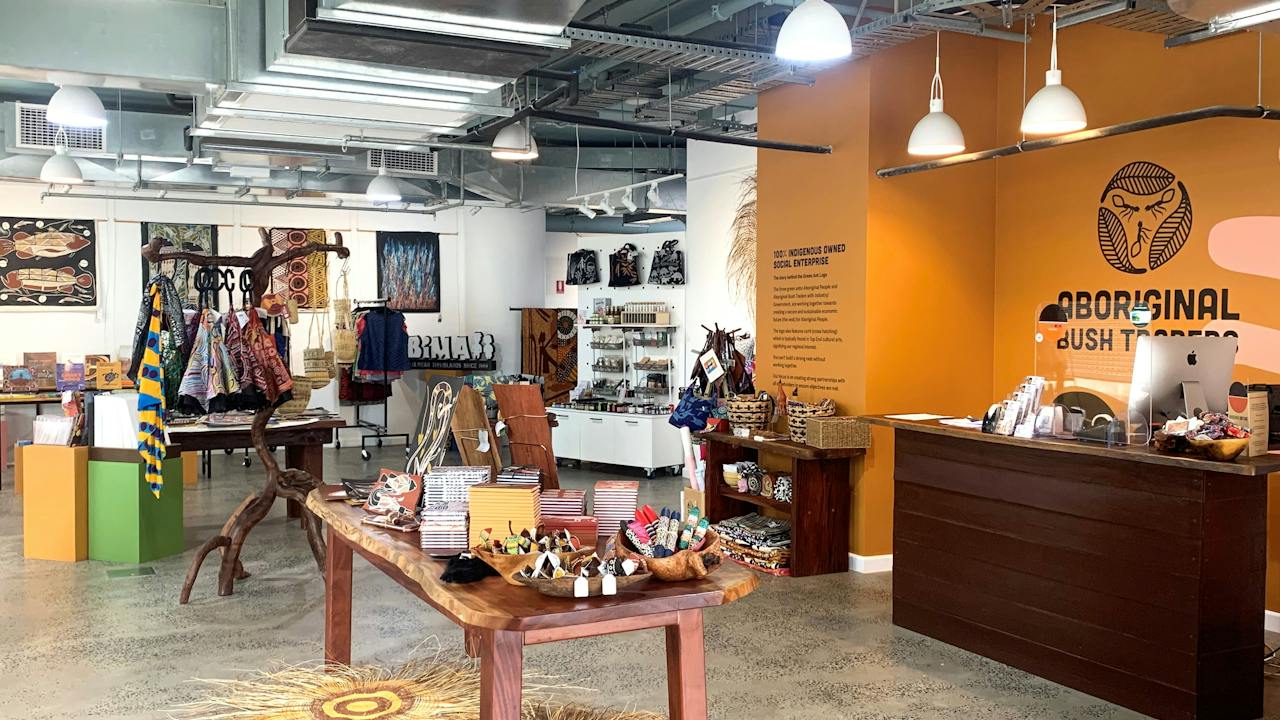
Gallery Interior
Image credit: Aboriginal Bush Traders

Galleries, Museums and Collections

Aboriginal Bush Traders

Aboriginal Bush Traders, connecting you with unique, authentic and ethical cultural products and experiences; supporting local indigenous artists, businesses and micro-enterprises. A retail store that melds high quality gift, art and authentic indigenous product experiences. Aboriginal Bush Traders is 100% not-for-profit, and provides avenues for Indigenous people wanting to engage in economic activities in a sustainable way. We specialise in unique, authentic and ethically-sourced products from across the Northern Territory.

Darwin City NT

0.1 km away

View place
Christ Church Cathedral Precinct

Historical Sites and Heritage Locations

Christ Church Cathedral Precinct

This precinct is highly valued by the community for a range of social, historic and architectural reasons. It consists of the Christ Church Cathedral (completed in 1977), the adjacent Cyclone Tracy ruins of the original Christ Church (1902) , and the associated memorial gate (1944) facing Smith Street. The church was constructed in 1902, consecrated by the Bishop of Carpentaria and named Christ Church on 2 November of that year. A vestry and rectory were added in 1917. In 1942, it was used as the Garrison Church for the Armed Services and escaped significant damage during bombing raids of 1942-43 but was looted and vandalised. The portico and memorial gate, constructed by the RAN, were added in 1944 using stone from the bombed post office. The Navy returned the church to the diocese in 1946. In 1968, the church became a cathedral. Cyclone Tracy destroyed all but front wall and portico, and these were incorporated into the new cathedral, constructed in 1976. The new Christ Church Cathedral was consecrated on 13 March 1977, the Archbishop of Canterbury in attendance. The new cathedral has been recognised for its architectural excellence and is a venue for important community events.

Darwin NT

0.1 km away

View place
Commonwealth Bank Building Darwin

Historical Sites and Heritage Locations

Commonwealth Bank Building Darwin

The former Commonwealth bank is significant as a symbol of the federal government's Civil and Defence Works Programme of the late 1930s. Displaying elements of Art Deco styling, the bank is a rare example of early modern architecture in Darwin. The building, as an architectural feature on a key intersection known as Banking Corner, makes a positive contribution to the central Darwin streetscape. The bank was completed in September 1940 and its design was then strikingly modern; the design also incorporated adaptations (eg, vents, overhangs) for climate control. The building was, and remains, a rare example of early modern movement architecture in Darwin (though later alterations have affected the integrity of the building's style to a degree). There is an office section in Bennett Street which was converted from former staff quarters. Construction of the bank reflected new commercial confidence in Darwin, stimulated by the defence build-up during the 1930s after a long period of stagnation. It suffered minor damage during early air raids on Darwin and was occupied by the Royal Australian Navy (RAN) for much of the war. Cyclone Tracy caused minor damage in 1974. The building was sold by the bank in 2005.

Darwin City NT

0.1 km away

View place
Administrator’s Offices and Cell Block

Historical Sites and Heritage Locations

Administrator’s Offices and Cell Block

This is the site of the 1870 Palmerston Police Station and cells. The original buildings were of crude timber and disintegrated because of white ants. In 1881, the stone cells at the rear of the site were erected. These were used until 1883 when prisoners were transferred to the new gaol at Fannie Bay. In 1884, a new court house and police station of stone and Cyprus pine, impervious to white ants, were constructed. The cells were used as police holding cells. The court house survived the bombing of Darwin on 19 February 1942, but the police station had to be demolished. The building then served as Naval Headquarters until December 1974 when it suffered significant damage during Cyclone Tracy. Several of the 1884 doors, windows, roof trusses and verandah posts were salvaged and the building reconstructed with some variations. Opening once again in 1981 as the offices of the Administrator, the building is significant as a rare example of early public buildings in Darwin. The office and cell block are significant because they represent the continuous presence of Westminster institutions in European settlement of the Territory.

Darwin NT

0.1 km away

View place
Reserve Bank

Historical Sites and Heritage Locations

Reserve Bank

The Reserve Bank was constructed in 1966-67 and is a particularly fine example of the twentieth century stripped classical architectural style. The generous curtilage upon which the building sits is an important part of the overall design and provides an appropriate setting for the building, which is a reminder of the role that the Reserve Bank of Australia played in the development of a centralised banking and monetary control system. This was reinforced by opening a branch of the bank in each capital city. The building is one of four buildings making up 'bankers' corner'. The others are the former Commercial Bank of Australia facade, the Commonwealth Bank and the Westpac Bank (former Bank of New South Wales). The garden and small circular fountain are part of the original building design. The bank closed on 31 October 1997. In 1999-2000 the building was occupied by the United Nations and became symbolic of Australia's role in the East Timor conflict.

Darwin NT

0.1 km away

View place
Big Bus Darwin

Amusement and Theme Parks

Big Bus Darwin

Discover Australia's Top End on the Hop-on, Hop-off Darwin Big Bus Tour! Big Bus Darwin tours provide the perfect introduction to Darwin, with top-deck views and stops near all the top landmarks and attractions. Hop on Hop off City Tour operating Monday to Saturday in the peak season, tickets can be purchased off the driver at any of the Big Bus stops. Some buses have air-conditioning, all buses are open air, with Canopy cover. Pre-recorded English commentary. 70 min loop in the morning. 90 min loop in the afternoon. (Peak season) Check website for latest operating times.

Darwin City NT

0.1 km away

View place
Westpac Bank

Historical Sites and Heritage Locations

Westpac Bank

This bank, constructed as the Bank of New South Wales in 1940, is emblematic of the Commonwealth Government’s £1.5 million civil and defence work programme between the years 1938 and 1941 when critical infrastructure was added to the town after years of stagnation and is an important element in the Bank Corner precinct of the central business district. The bank was damaged during bombing raids in 1942 and again during Cyclone Tracy in 1975. On each occasion it was repaired and refurbished so little of its original fabric remains, although it retains its Colonial Revival style, which contrasts with its three counterparts on Bank Corner. The Westpac Bank building is valued by the community as an inner-city pre-war structure and as part of the essential commercial infrastructure of any city.

Darwin City NT

0.2 km away

View place
Commercial Bank

Historical Sites and Heritage Locations

Commercial Bank

Built for the Town and Country Bank in 1884, it was possibly the first building built of stone by private enterprise. In 1887 the building became the premises for the Commercial Bank of Australia. It survived World War II bombing and minor damage by cyclone Tracy, however only the facade remains today.

Darwin City NT

0.2 km away

View place
Survivor’s Lookout

Historical Sites and Heritage Locations

Survivor’s Lookout

Survivor's Lookout, located near the Esplanade, provides sweeping views over the sparkling blue Darwin Harbour and commemorates those brave Darwin citizens who survived the Bombing of Darwin in 1942. Interpretive signage at the lookout tells the stories of resilience and survival following the first and largest attack on Australian soil during World War II.

Darwin NT

0.2 km away

View place
Mbantua Gallery Darwin

Galleries, Museums and Collections

Mbantua Gallery Darwin

Mbantua Aboriginal Art Gallery specializes in art from the Utopia Region in Central Australia. Mbantua Aboriginal Art Gallery's history with the people of Utopia stretches close to 40 years now and to this day we are still strongly connected with these very independent artists. Also stocking unique jewellery and opals, handcrafted sculptures and beautiful and ethically sourced souvenir range. Open everyday except public holidays.

Darwin NT

0.2 km away

View place
Larrakia/Mayalli artist Keelan Fejo and Brittany with his artwork at Liberty Square
Image credit: C+K Public Art

Historical Sites and Heritage Locations

Liberty Square Darwin

Liberty Square is a landscaped park located between Parliament House and the Supreme Court. Liberty Square features the heritage listed State Square Banyan Tree. Artwork by Larrakia/Mayalli artist Keelan Fejo is embedded in a seating area on elevated decking surrounding the tree, which is culturally significant for local Larrakia people. At more than 200 years old this banyan is a remnant of the original monsoon vine forest. It has survived cyclones, bombs and extensive development. In 1994, the tree was permanently protected under the Heritage Act 2011 for its significance in Darwin's history. 'Liberty Square' was named by Darwin Town Council in 1919 and commemorates the Darwin Rebellion of 17 December 1918. Hundreds of workers marched to this site, protesting the government's actions, resulting in a Royal Commission into the administration of the Northern Territory. The Cable Station, responsible for maintaining the sub-sea communications cable which stretched from Indonesia to Darwin where it joined the Overland Telegraph Line, was built here in the 1870s. It was extensively damaged by bombing during WWII. A commemorative monument built from original cable station stone is located next to Parliament House. Liberty Square also features an astronomical observation pillar by Pietro Baracchi who, with others, established the true longitude of Port Darwin in 1883 in the grounds of the Port Darwin Post Office (Parliament House).

Darwin City NT

0.2 km away

View place
State Square Banyan Tree.

Historical Sites and Heritage Locations

State Square Banyan Tree

The Banyan Tree in State Square is valued by the community as a remnant of the original Darwin foreshore vegetation. It is over 200 years old and was the congregation point for the Larakia youths prior to ceremonies which took place under the nearby Tamarind tree. The large mature banyan tree is growing near the Supreme Court building within State Square. The tree is in a large open grassed area and is surrounded by a low garden bed. The tree is of significance and provides a shady place to sit in the city.

Darwin NT

0.2 km away

View place
Readback Aboriginal Art Gallery

Galleries, Museums and Collections

Readback Aboriginal Art Gallery

Readback has been in business in Darwin since 1995. Their Authentic, Affordable Aboriginal Art is purchased ethically and direct from local indigenous men and women artists right here in the heart of Darwin in the Northern Territory. Buying locally allows them to support, promote and offer a steady income to their skilled artists. Readback Aboriginal Art Gallery gets asked time and time again “why are your prices so low compared to others?” The answer is simple, and they practice fair trade. This enables them to offer low, competitive prices and allows customers to make socially conscious purchases. Also, their prices stay the same all year round, with no raising prices in the popular dry season. Readback Aboriginal Art Gallery is fortunate to have talented artists such as the renowned Numina Sisters and their mother, Barbara Pananka Price Mbitjana, just to name a few. Their artists are welcome to take up residence in the gallery section to paint. This is a unique experience to see them in action, and talk to them about their paintings and culture. All artwork is signed by the artist on the back of the painting and comes with a Certificate of Authenticity with a photo and information about the artist and the piece.

Darwin City NT

0.2 km away

View place
Star Village, Smith Street Mall, Darwin

Historical Sites and Heritage Locations

Star Village, Smith Street Mall, Darwin

Named after the Star Theatre, the Star Village is significant to the social history of Darwin. The theatre was the second open-air theatre in Darwin and renowned for the many great movies screened there, including the infamous 'western' nights. Harold Snell bought the block in 1928 and built the theatre, which opened on 14 September 1929 with seating for 860 people, offices and a milk bar. He sold the theatre to Christina Gordon and sons in 1930. Tom Derreck Harris was the manager at the time and sometimes organised live entertainment. In 1941, Harris leased the theatre from the Gordons. Like most other buildings in Darwin, the theatre was compulsorily acquired by the military during World War II and was not returned to the Gordons until 1951, although the public was allowed back to the theatre in 1946. Harris was granted a lease over the building in 1952 and in 1958 installed air-conditioning and undertook some modernisation. The theatre was destroyed in Cyclone Tracy in 1974. Tom Harris Junior built the Star Arcade in 1980. The name is a reminder of the part the theatre played in the cultural life of Darwin for 45 years

Darwin City NT

0.2 km away

View place
WWII Navy Oil Storage Tunnels 5 & 6, Darwin

Historical Sites and Heritage Locations

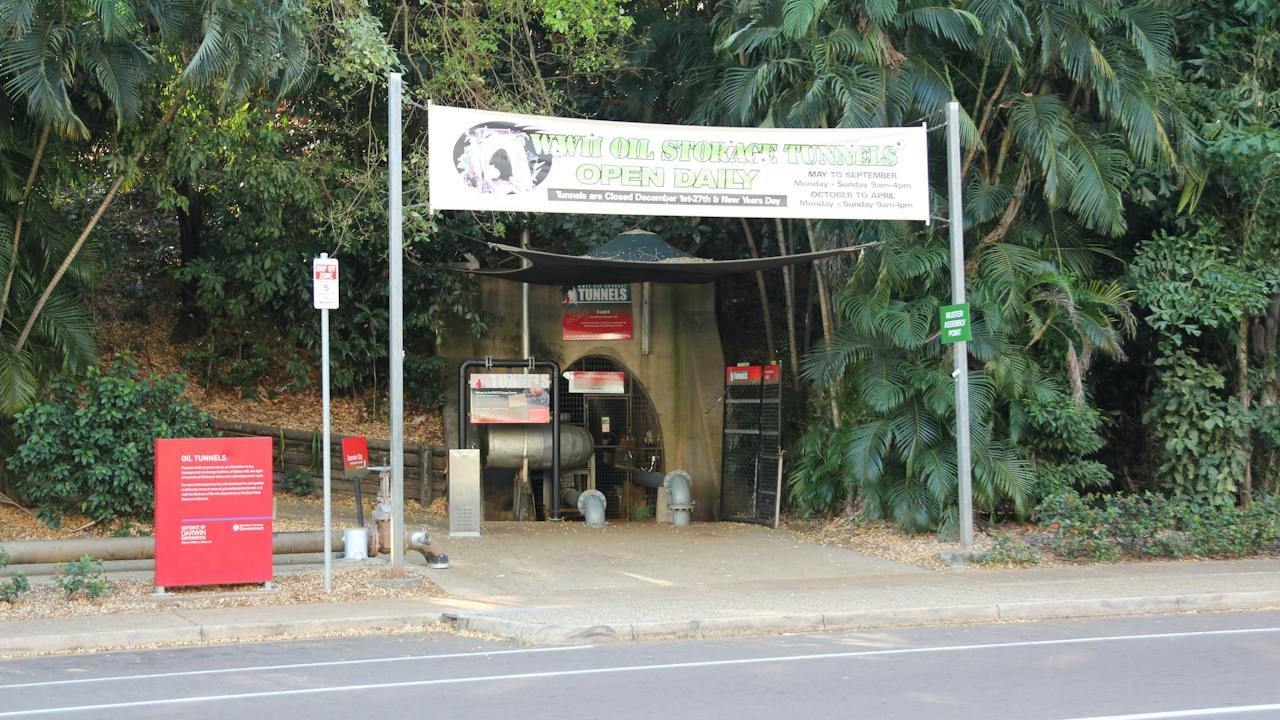
WWII Navy Oil Storage Tunnels 5 & 6, Darwin

During World War II vulnerability of standard fuel storage tanks to aerial bombing stimulated the innovative approach of underground fuel storage in concrete and steel lined tunnels. Construction of the tunnels was part of an overall defence strategy for Australia and the Pacific region. In 1943 contractors Johns and Waygood commenced building the storage tunnels, finishing number 11 in 1946 after war's end. Difficulties and delays in construction, material deficiencies and the inability to effectively seal the tunnels from infiltration of water meant that the tunnels were never used for their intended purpose. Despite this they are evocative of the desperate years when the Japanese were pressing their attack on mainland Australia and the Top End, in particular as the 'sharp end' of our defence effort. The tunnels are redolent of the immense difficulties of maintaining defensive operations so far from supporting industrial infrastructure in unfamiliar conditions. They are unique in Australia and are a symbol of the dogged determination and willingness to try against the odds that characterises the defenders of Australia.

Darwin NT

0.2 km away

View place
Stacks of Damadi's artisan soaps being arranged by the maker.
Image credit: Damadi

Shopping and Markets

Damadi Artisan Soaps and Skincare

Gloriously scented with natural essential oils, Damadi's artisan soaps and skincare are delicately crafted in Darwin, tropical north Australia. Made with ingredients like Kakadu Plum and Australian grown Jojoba oil, its created with the aim of delighting the senses and returning the skin to its supple best. While you're in store, have a look in the curing room and find out more about how soap is crafted. Perfect for gift giving, there are things to suit everybody. As a bonus, it can be gift wrapped, making life easy for you. Follow your nose into the Star Arcade and you will find the tiny Damadi store surrounded by decades of history going back to its early days in the 1930's when it was the first open air movie cinema in Darwin. There's also a sculpture with World War II memorabilia to commemorate Darwin's valiant efforts during turbulent times. Damadi, its more than a shop, its an experience and a story. Take a little piece of the tropics home with you.

Darwin City NT

0.2 km away

View place
Traveller’s Walk

Historical Sites and Heritage Locations

Traveller’s Walk

Prior to the Stuart Highway upgrade during World War II, visitors usually arrived in Darwin by ship. From at least as early as the 1880's, passengers disembarked at the Port of Darwin and climbed the escarpment via the walkway to town known colloquially as Chinaman's or Traveller's Walk. The path began at the railway yards with steps up to Cavenagh Street and finished at the Terminus Hotel.

Darwin City NT

0.2 km away

View place
Hughes Avenue Darwin

Historical Sites and Heritage Locations

Hughes Avenue Darwin

Hughes Avenue, incorporating the lime kiln walk, is historically significant as one of the first roadways established in Darwin. From 1869, Hughes Avenue served as the main pedestrian and transport corridors between Goyder's Camp and the port below, and the town of Palmerston with newly established government buildings on the escarpment on the plateau above. The Hughes Avenue alignment was used to transport goods from the jetty area to the growing city above until completion of Stokes Hill Wharf in 1887. The current alignment of Hughes Avenue is virtually identical to that established by Goyder and his party. Beginning opposite the Courthouse and Police Station (Administrator's Offices) at the end of Smith Street, the descent along Hughes Avenue provides views of Government House on the hill above and vistas of the port and harbour below. These provide an insight into the daily activity experienced by Goyder and the first Europeans who landed in Port Darwin in February 1869.

Darwin City NT

0.2 km away

View place
Victoria Hotel (the Vic), Darwin

Historical Sites and Heritage Locations

Victoria Hotel (the Vic), Darwin

The Victoria Hotel (‘the Vic’) has been a Darwin institution since its opening in July 1890 and would be, according to the NT Times and Gazette, the ‘best and most commodious hotel north of Townsville’. Commissioned by Ellen Ryan, then of Grove Hill, it was a two-storey porcellanite construction. Initially named the North Australia Hotel, it was renamed Victoria on 11 September 1896. The hotel is an icon of the Darwin cityscape and was the grandest hotel in Palmerston for many years. Ellen Ryan hosted a number of VIP guests, including Mr Justice Dashwood and family and the South Australia Premier, Sir Thomas Playford, in 1892. All hotels in the northern part of the Northern Territory were nationalised by the Australian Government in September 1915 after which the Administrator, the contentious Dr JA Gilruth, ordered the closure of public bar in the Vic Hotel, causing acrimony among already agitated working men. Thus the Vic has an association with the Darwin Rebellion of December 1918 and the issue of political representation for Northern Territory citizens. The Vic has survived three major cyclones and World War II, during which it was compulsorily acquired by the Navy then relinquished in 1945.

Darwin City NT

0.2 km away

View place
Colourful choices

Shopping and Markets

Albertini

Albertini is a concept label featuring Aboriginal printed fabrics from remote communities of the Northern Territory, Australia. Each gown is unique in print, design or colour and identifies the artist and art centre to its artwork.  Australian wearable art which you can proudly showcase as an original fashion statement. Albertini offers a range of styles from casual wear, day wear and evening couture pieces. Incorporating the art work from the Indigenous artist, each piece has its own identity with a story behind its creation. Fabrics are printed by the artist using their own art work, then given back to designer Adriana, who develops the garments to best incorporate the print.

Darwin City NT

0.2 km away

View place
See the precinct come to life at night
Image credit: Darwin Waterfront Corporation

Entertainment Venues

Darwin Waterfront

The Darwin Waterfront is in the heart of Darwin's CBD just walking distance from Smith Street Mall and the Esplanade. Experience the best of Darwin's tropical lifestyle with lush parklands, a man-made beach along the saltwater recreation lagoon, and Darwin's most popular attraction, the Wave Lagoon. Dine on around the world cuisine as you refuel after a morning swim, linger over a luxurious lunch, or stop for a sundowner. Choose from high-end Mediterranean and Mexican restaurants, to more casual cafes and bars - you'll never be too far from an ice cream or a cocktail! Experience Darwin's multicultural and vibrant community with a year-round program of activities, festivals and events. Explore Stokes Hill Wharf, a favourite fishing and fish-and-chip spot and popular starting point for harbour cruises where you can experience the best of Darwin Harbour aboard sunset cruises, fishing tours or 00Seven Jet Ski Adventures. There's so much to love at Darwin Waterfront.

Darwin City NT

0.3 km away

View place
Beach Club at Darwin Waterfront

Entertainment Venues

Darwin Waterfront Beach Club

An annual dry season activity, the Darwin Waterfront Beach Club is open every day, a free, public space, featuring luxurious day beds, umbrellas, comfortable seating and the popular Beach Bar! Order food from one of the local venues or grab a drink from the Beach Bar which is open every day from midday until 7pm.

Darwin City NT

0.3 km away

View place

What is happening now?

Search dated events, markets, live music, sport and community activities.

Explore Events

Planning by place?

Use Things to Do for attractions and experiences that are not tied to one event date.